Appeal Briefs
This is a selection from Zara’s hundreds of federal and state appeal briefs. Names, dates, and other identifying details have been changed to protect privacy. Cover pages and tables have been removed for ease of reading.
2nd Circuit Court of Appeals, Appellee Brief. The defendant was sued for rescission of a contract for the sale of a piece of art that ended up being a fake. The defendant was pro se in the motion court, but Zara helped him find the argument that an art buyer has a duty to investigate a piece of art prior to completing a purchase. The defendant moved to dismiss, and the District Court granted it. The plaintiff appealed. With this defending brief and Zara’s oral argument, the Second Circuit denied the appeal, and upheld the dismissal.
Fifth Circuit Court of Appeals, Appellant Brief. This was a §1983 action against a small-town police department. A sergeant — the department's K-9 officer, in charge of confidential informants who was the plaintiff's ex-husband — had a former informant plant drugs under her car, then called a traffic officer to tell him where to look. The ex-wife was arrested and lost custody of her children for a month. Officers had warned the police chief beforehand about the sergeant’s plan, but he took no action. The District Court dismissed the claims against the town on summary judgment. Our brief focused the municipal-liability analysis into the single-incident failure-to-supervise exception, which resulted in the dismissal being reversed and the ex-wife’s claims reinstated.
Ninth Circuit Court of Appeals, Appellee Brief. Defending a grant of summary judgment in favor of a data-center operator sued for contributory copyright and trademark infringement over images on a site it did not run. Addressing the DMCA safe harbor and primary contributory liability, while using the statute's "other defenses not affected" clause to bolster the District Court’s reasoning, this brief successfully defeated an appeal by a plaintiff seeking to impose a novel theory.
District of Columbia Circuit Court of Appeals, Petitioner’s Brief. In this case of first impression, the FAA issued an emergency cease-and-desist order that shut down a veteran flight instructor’s training program. The FAA’s reasoning was flawed on two levels: the emergency finding was a bare conclusion with no evidence behind it, and the rule applied was not ambiguous so the agency’s interpretation was entitled to no deference. (This case was litigated before the Supreme Court’s decision in Loper Bright Enterprises v. Raimondo, 603 U.S. 369 (2024), which overturned the longstanding Chevron doctrine mandating Circuit Courts to defer to agency interpretation of ambiguous statutes).
Ninth Circuit Court of Appeals, Appellee Brief. A buyer ordered millions of masks during Covid then refused to pay, claiming a defect in the product and a rescission of the contract. The District Court granted judgment in favor of the supplier. This brief defended the more than $1 million win against all of the defendant’s evidentiary arguments.
New York Appellate Division, Second Department, Appellant’s Brief. An owner of a construction project sued a subcontractor for breach of contract and argued it was the third-party beneficiary of the contract between the general contractor and the subcontractor. The motion court refused to dismiss the claim, despite there being no privity of contract between the owner and the subcontractor. In our brief, we attacked an unhelpful Second Department precedent head-on by arguing the precedent had been implicitly overruled by a later Court of Appeals decision and the Second Department’s own intervening cases could not be squared with the law set by the Court of Appeals. The Second Department agreed and reversed, and the decision is now regularly cited in the Second Department on subcontractor privity and third-party beneficiary status.
*Note* Names and details in the brief were changed for publication here. Get in touch to request a copy of the reported decision.
New York Appellate Division, First Department, Appellant’s Brief. The servicer failed to send a notice of default to the borrower under the terms of the mortgage. The motion court granted the bank summary judgment despite this fact. On appeal, we convinced the First Department to reverse the motion court’s order and dismiss the complaint.

New York Appellate Division, Second Department, Responding Brief. The client won in the motion court but there was a big problem: the judge relied on a repealed statute to ground the holding. We defended the order relying on a lesser known appellate doctrine, which permits affirmance despite a motion court’s clear error. The persuasive effect of the brief worked – the Second Department affirmed.
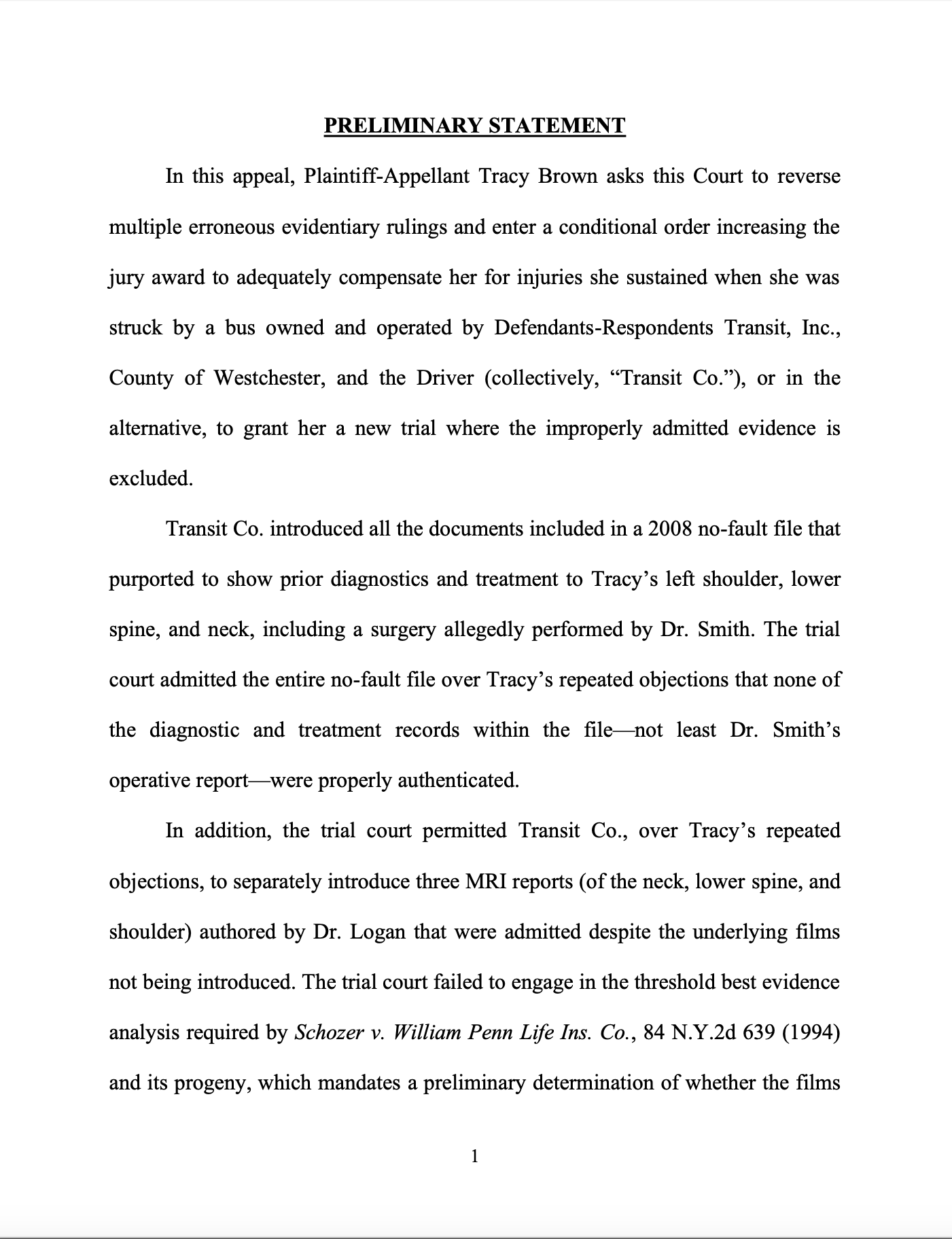
New York Appellate Division, First Department, Appellant’s Reply Brief. In a damages-only trial after a bus struck the plaintiff, the defense introduced an entire twenty-year-old no-fault insurance file, including a pathology report for a shoulder surgery the plaintiff denies ever having. The proof was through MRI reports whose underlying films had been destroyed. This reply recast what the respondent called a credibility contest and a battle of the experts, presenting the central issue as a threshold admissibility question the trial judge was required to decide first. The First Department rejected our primary argument but adopted the other arguments, reversing and ordering a new trial on damages.
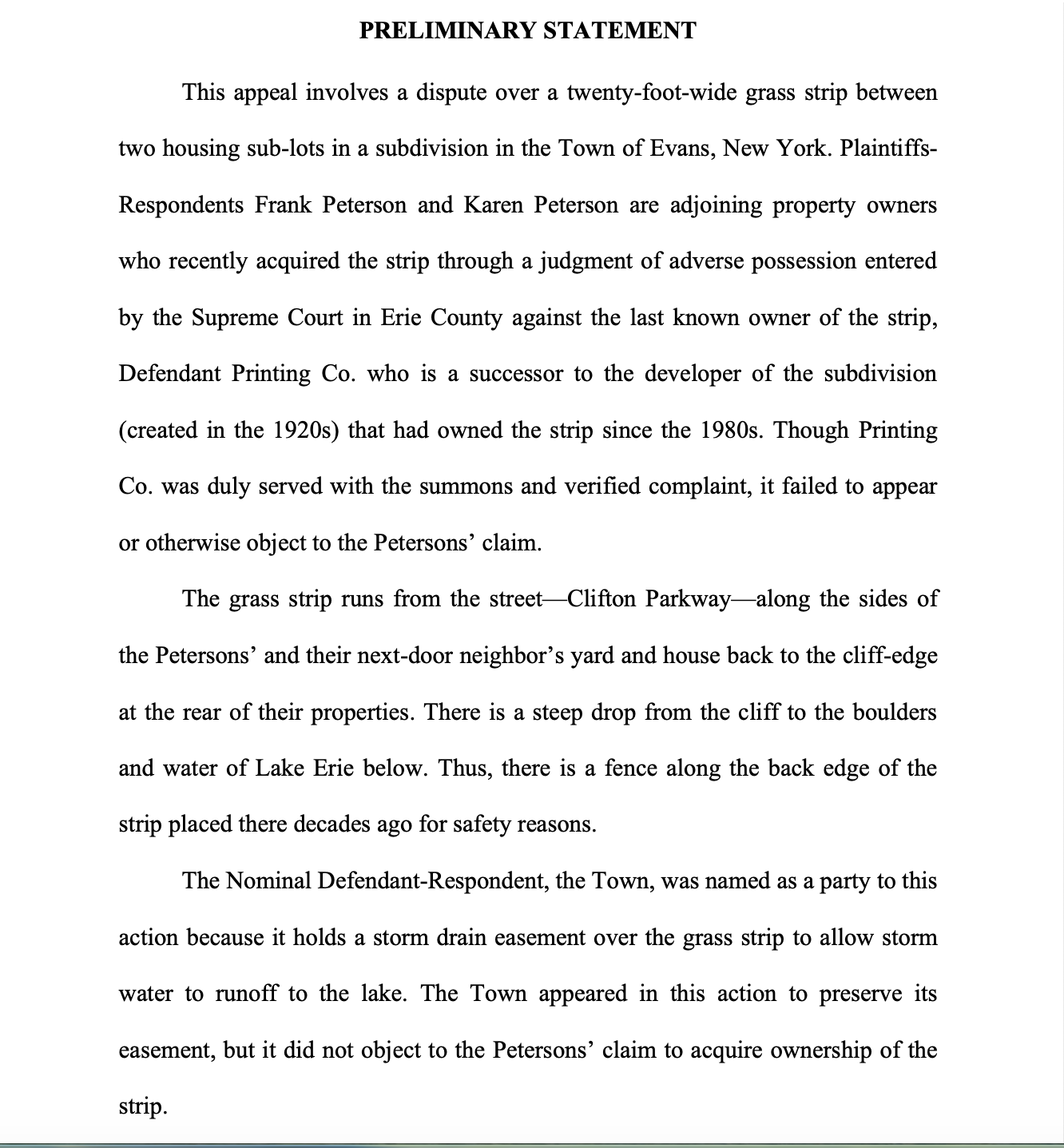
New York Appellate Division, Fourth Department, Respondent’s Brief. This brief defended a default judgment of adverse possession, resolving a dispute over a twenty-foot grass strip. The appellant was a neighbor who brought a motion to vacate relying on the “paper street” rule. Our brief showed why the rule did not apply, and why the doctrine of “tacking” allowed the respondents to establish the time required for a finding of adverse possession. Two obscure property doctrines intersecting to bring relief to a homeowner. The court agreed and unanimously affirmed.
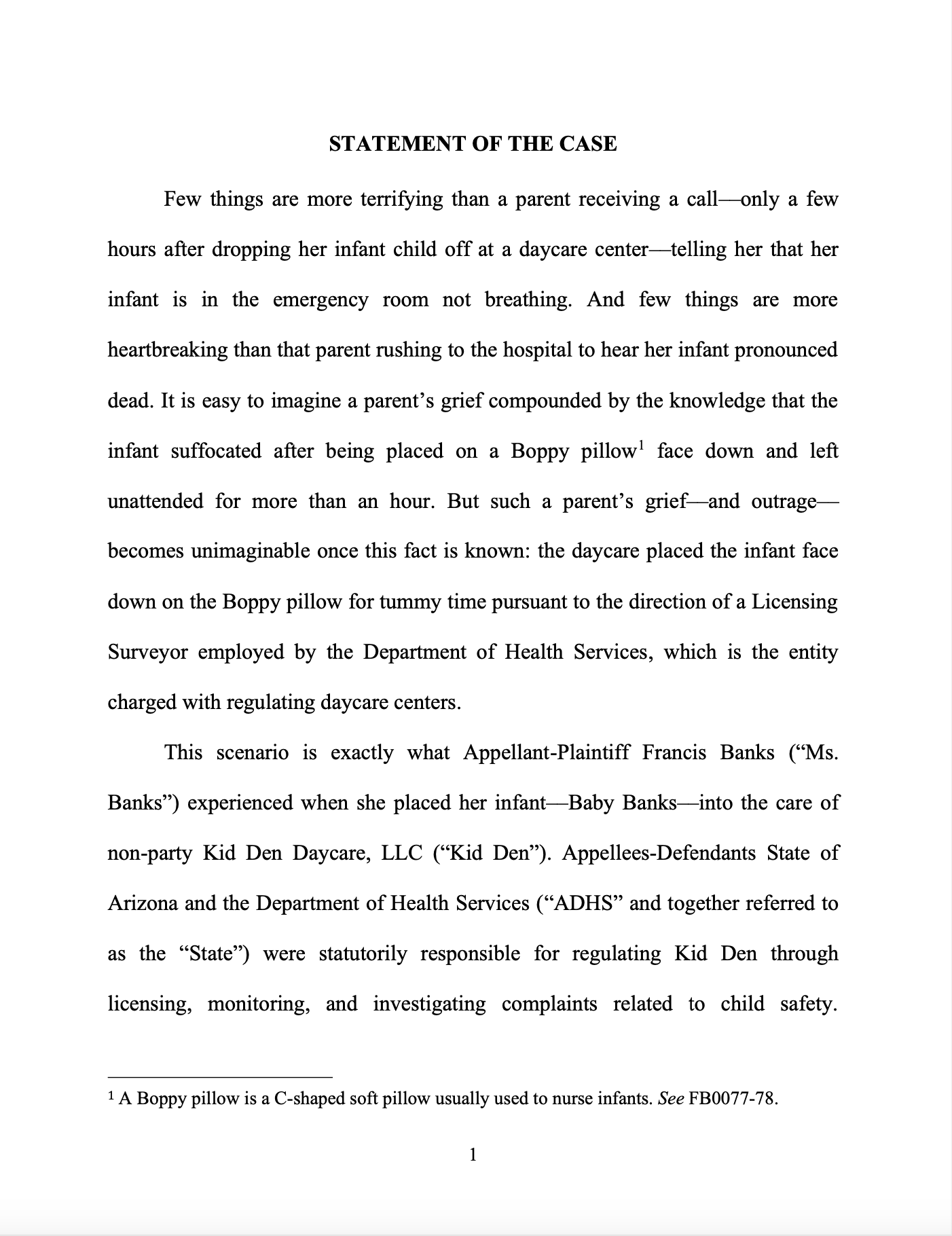
Arizona Court of Appeals, Appellant’s Brief. In this action against the State and its employee, brought by the plaintiff after an infant suffocated on a tummy pillow, the trial court dismissed based on no duty and absolute immunity. Our brief distinguished a failure-to-inspect case — where the state is immune and owes a duty only to the public at large — from a misfeasance case where the state did not fail to act, but rather acted in a way that caused harm. That reframing provided legal ground where absolute immunity does not reach. The Court of Appeals reversed and reinstated some of the claims.
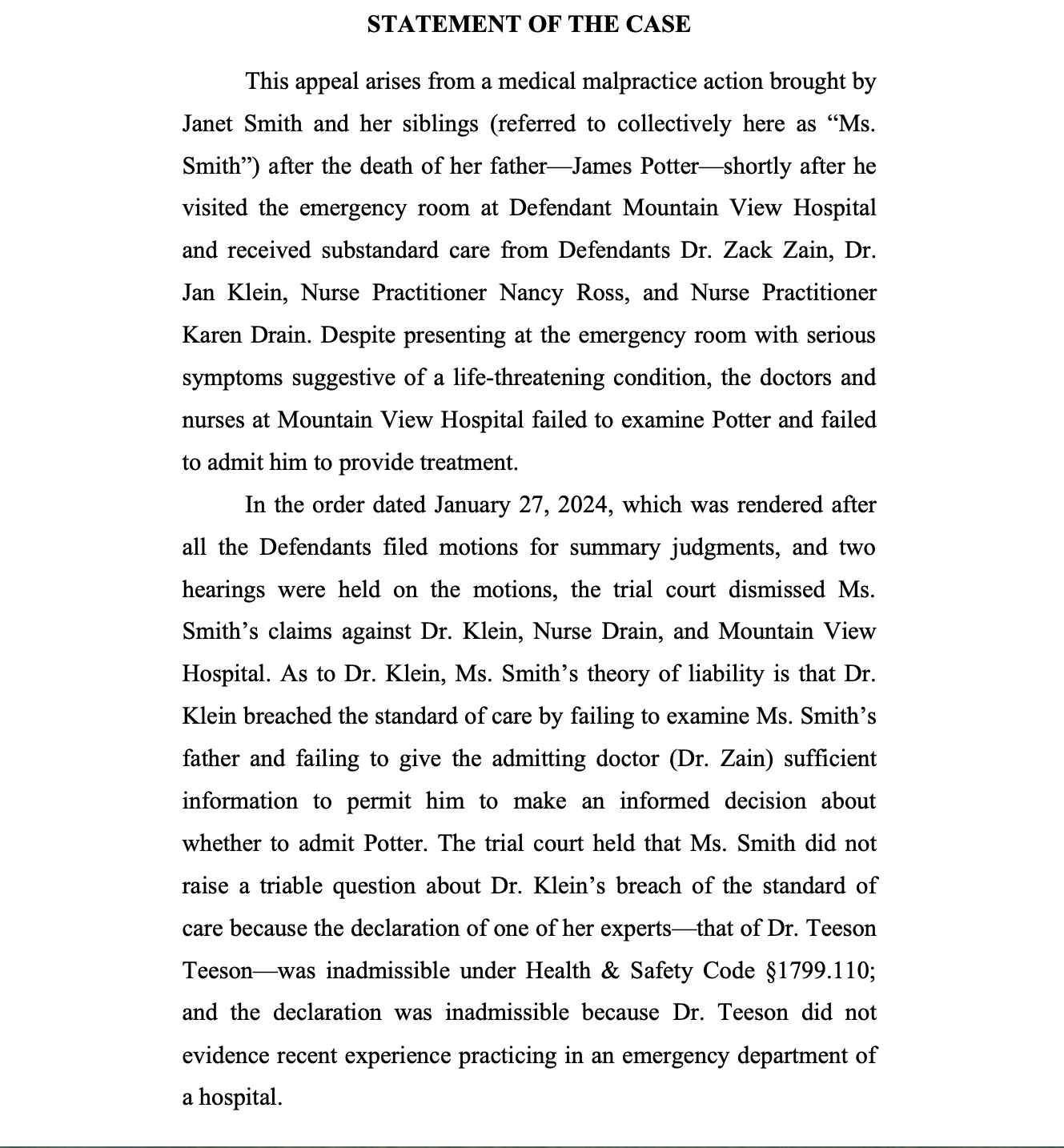
California Court of Appeal, Appellant’s Brief. A man died hours after an emergency room sent him home without a physician ever examining him. The trial court granted the emergency physician summary judgment after excluding the plaintiff's expert declaration under a statute requiring substantial recent emergency-medicine experience "in the same or similar localities." This brief examines the statute to show that nothing in the text requires the experience to have been gained in the locality where the malpractice occurred – because if the Legislature had meant to confine plaintiffs to local experts, it would have said so.
Massachusetts Appeals Court, Respondent’s Brief. After Plaintiff Respondents purchased property at a foreclosure auction, the deceased homeowner’s daughter mounted a challenge to her eviction, as well as the mortgage in the preceding foreclosure. She lost in the trial court, and filed an appeal with no less than 21 issues for review along with a stream of consciousness statement of the facts. In this brief we cut through the slop and narrowed the issues for the court’s review. Clarity is what the Appeals Court needed to affirm the judgment.
Pennsylvania Superior Court, Appellant’s Brief. A landlord was held in civil contempt of a settlement order and hit with a $100K+ judgment after a dispute over the tenant's belongings. The brief attacked the fine’s legal basis: a civil contempt fine must either coerce compliance or compensate a proven actual loss. This one did neither because the trial court grounded the award in a treble-damages statute and applied it to conduct predating the order it was enforcing. We argued the judgment both exceeded the contempt power and, to the extent it was compensatory, failed for want of proof. The Superior Court agreed, and the judgment was vacated.
New Jersey Appellate Division, Appellant’s Brief. A flooring subcontractor's collection suit was dismissed with prejudice for want of subject-matter jurisdiction, because its certificate of authority had lapsed before it filed. The brief showed that the statute’s bar reaches a foreign corporation "transacting business in this State without a certificate of authority" — not one that simply let its certificate lapse after it finished the work. In addition, dismissal with prejudice was error. The Appellate Division reversed, reinstated the complaint, and remanded the action.
New Jersey Appellate Division, Respondent’s Brief. Defendant a grant of summary judgment for a commercial landlord and its ground tenant. A customer walked up a loading ramp alongside a cargo van and was struck when a door opened; a marked customer entrance with a staircase and a bell sat a few feet to the side. Rather than contest her status as a business invitee, this brief argues that status no longer generates duty in New Jersey — foreseeability and fairness do. And because the mode-of-operation rule and invitee law both presuppose a dangerous condition, the absence of any defect in the ramp defeated the plaintiff’s theories.
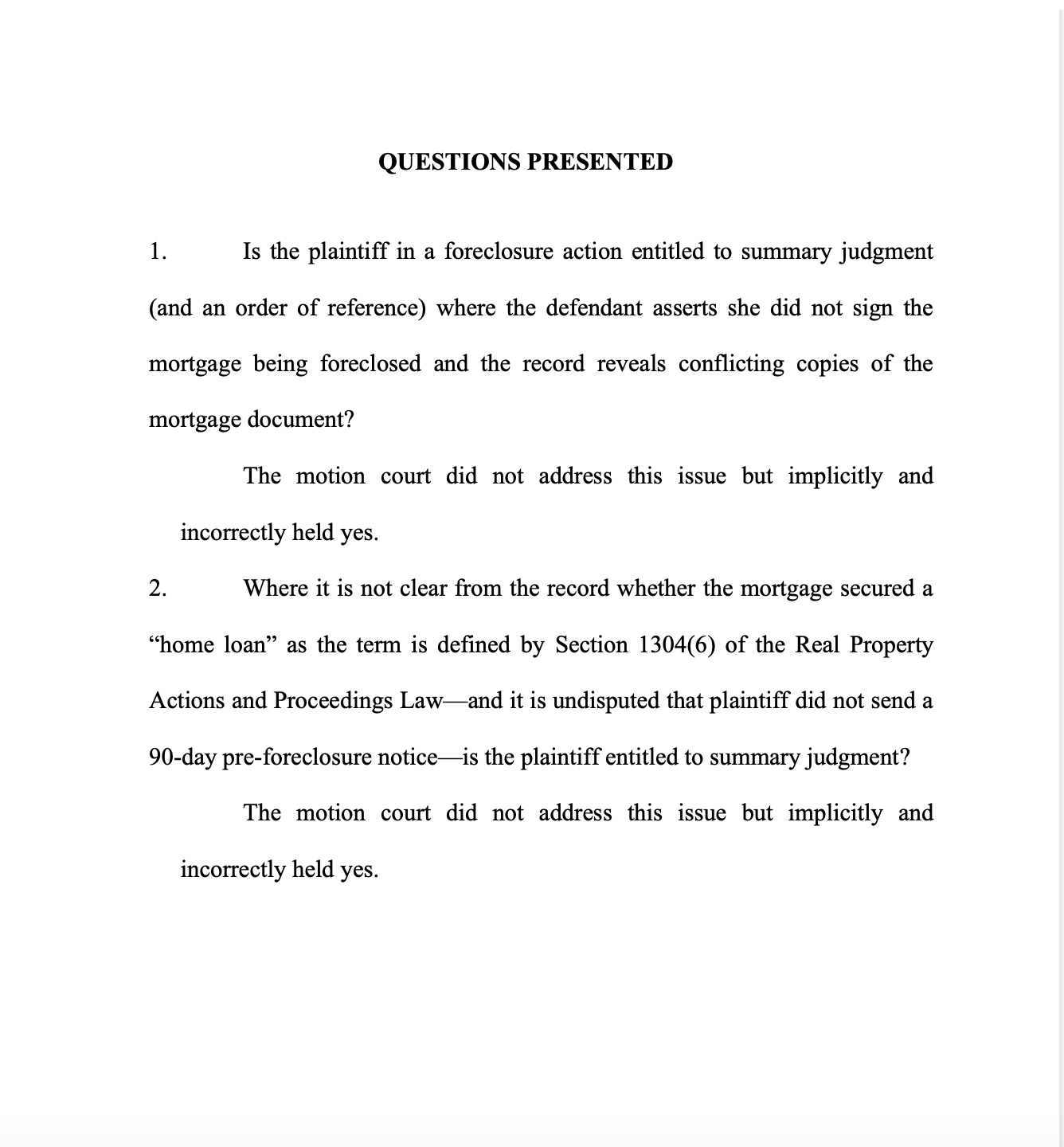
New York Appellate Division, Second Department, Appellant’s Brief. This appeal involved a private note-holder’s attempt to foreclose a mortgage that was procured by fraud. The client represented herself pro se in the motion court, and her protestations that she did not sign the mortgage being foreclosed were repeatedly ignored. This brief finally got the point across – and it led to the private note-holder withdrawing the entire foreclosure action.
New York Appellate Division, Second Department, Responding Brief. In this humorous case, a business leader was sued for criticizing his colleagues and allegedly breaking their agreement. The motion court held the business leader was not liable for defamation for telling his colleagues they have a “Midas broken touch.” We drafted a brief that was enjoyable to read, and the Second Department upheld the dismissal judgment.